Law 50 · Trust & Coordination
Preserve Provenance
Don't lose where a fact came from.
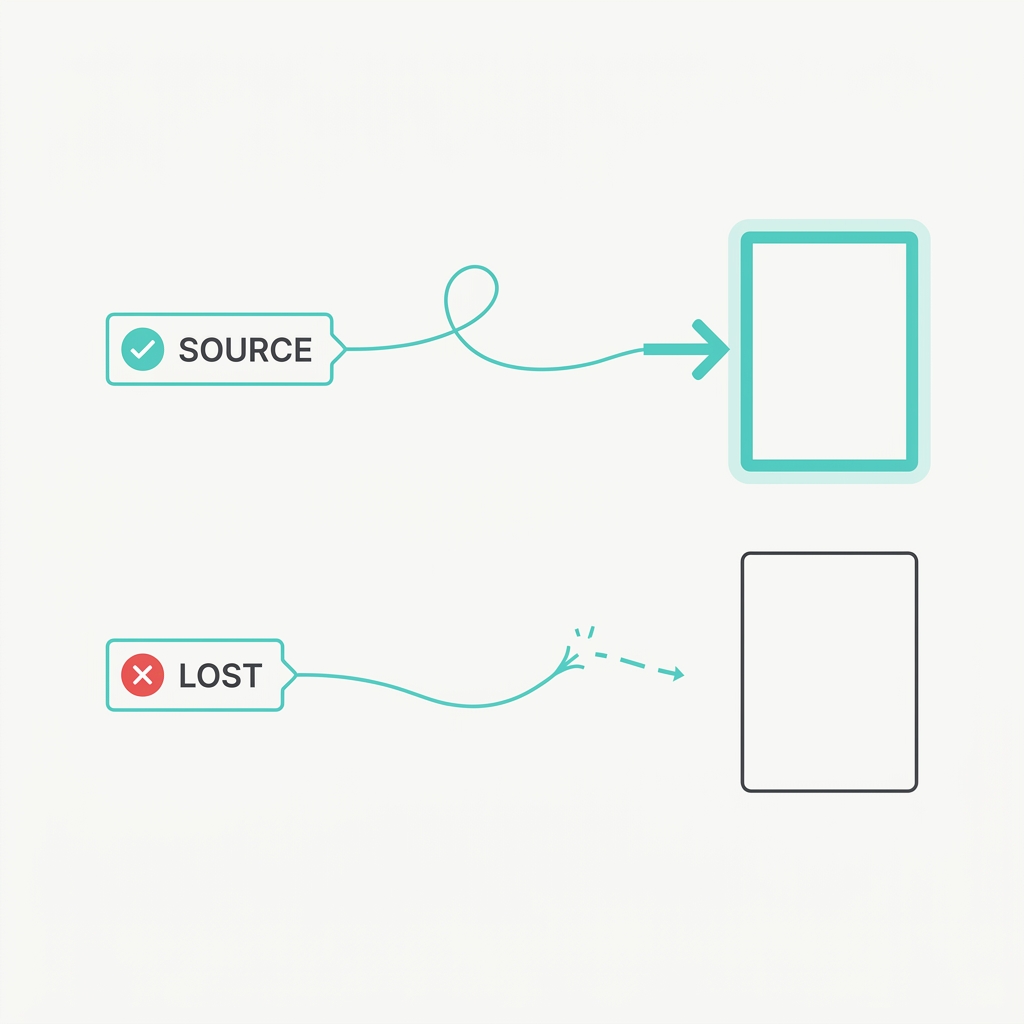
The principle
When findings get summarized and re-summarized, the claim survives but its source, its date, and its uncertainty quietly fall away — until you're holding an assertion you can't verify or defend. Two sources disagreeing isn't noise to flatten; it's signal to keep. A fact without provenance is a rumor with good posture.
Why it happens
Each summarization pass is a lossy compression that preserves the surface claim while discarding the metadata that lets you trust it: the source, the date, the uncertainty, and any disagreement between inputs. After a few hops a hedged, dated, conflicted finding collapses into a flat assertion with the same confident shape as a verified fact, which is why a claim without provenance is a rumor with good posture. Research on grounded generation treats this as a measurable property, attribution, where every claim should be traceable back to a supporting source, and benchmarks like ALCE evaluate generated text on exactly that citation faithfulness. The practical fix is to carry the full tuple, claim plus source plus date plus confidence, through every transformation rather than only the claim. Conflicts in particular must be preserved with both sides attributed, because a disagreement between two sources is signal about reliability, not noise to be flattened into a single winner.
Watch for
- A final report states a figure or claim with no source, date, or confidence attached.
- Two sources that disagreed upstream have silently become a single confident number downstream.
- You cannot trace a claim in the output back to the specific document it came from.
In practice
A research agent reads a 2021 blog post and a 2024 official filing, summarizes both into 'revenue is around $40M', and three hops of re-summarization later your final report states that figure as flat fact with no date, no source, and no hint that the two inputs actually disagreed. A claim without provenance is a rumor with good posture: you cannot defend it, audit it, or weigh it. Carry the full tuple through every transformation, claim plus source plus date plus confidence, and when sources conflict, keep both with attribution instead of silently crowning a winner. The disagreement is signal, not noise to flatten away.
Apply it
- Carry claim, source, date, and confidence together through every summarization and transformation step.
- When sources conflict, keep both values with their attributions instead of silently picking a winner.
- Require that every claim in the final output be traceable back to a specific supporting source.
The takeaway
Carry attribution through every transformation: claim, source, date, confidence. Preserve conflicts with both sides attributed instead of silently picking a winner, so downstream can audit, weigh, and trust.