Law 48 · Trust & Coordination
The Escape Hatch Law
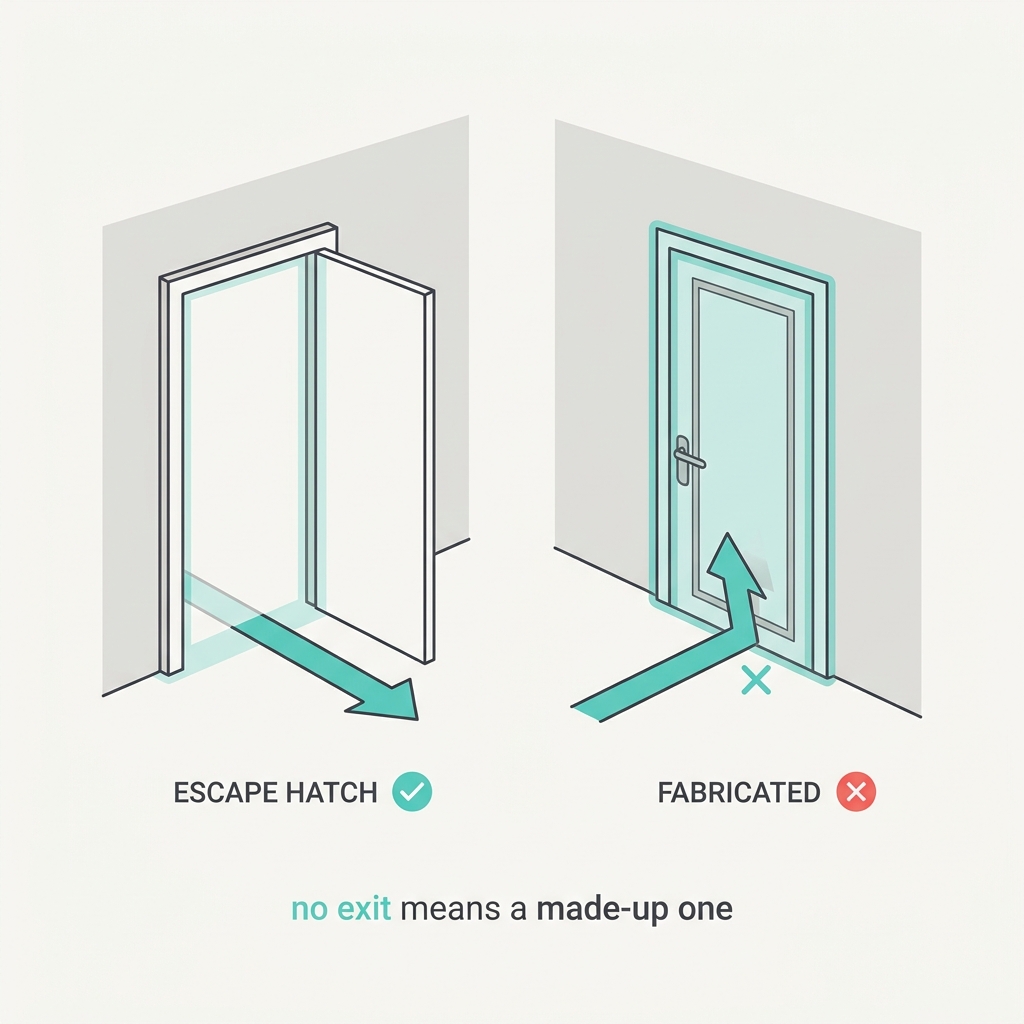
No clean exit means a fabricated one.
The principle
An agent with no legitimate way to say 'I'm stuck' or 'hand this to a human' will invent a path instead. Cornered without an exit — or forced to fill a required field it has no answer for — it fabricates something plausible rather than admitting the gap. A confident hallucination is the default when honesty isn't an option.
Why it happens
A model is a fluent continuation engine, not a truth-teller, so when honesty is not an available output it produces the most plausible-looking token sequence instead, which is a confident fabrication. The survey literature on hallucination frames this as the model generating content that is fluent and confident but unsupported by or in conflict with the available evidence, and a major contributing factor is the pressure to always produce an answer. If a required field must be filled or a workflow offers no I am stuck branch, the only path forward the model has is to invent something that satisfies the schema. The fix is to make abstention a first-class, low-cost option: a nullable field, an explicit unknown value, or an escalate-to-human action. When I do not know is a valid and easy answer, the model no longer has to choose fabrication to keep moving, and you trade confident errors for honest, actionable gaps.
Watch for
- Required fields are never empty, even on inputs where the answer genuinely cannot be known.
- The agent has no action that means hand this to a human or I cannot do this.
- Plausible but wrong values appear in exactly the cases where the source data was missing or ambiguous.
In practice
Your intake agent has a required customer_id field and no way to signal it could not find one, so when a query arrives with no match it confidently invents a plausible-looking ID and pipes a ticket into the wrong account's history. Cornered without a clean exit, a model fabricates rather than admits the gap; the hallucination is the default, not the anomaly. Give it a first-class way out: a nullable field, an explicit unknown enum, an escalate-to-human tool it is encouraged to call. When 'I do not know' is a valid, easy answer, you trade confident fabrications for honest gaps you can actually act on.
Apply it
- Give the agent a first-class way out: a nullable field, an explicit unknown, or an escalate-to-human action.
- Make abstaining cheap and explicitly encouraged rather than something the agent must avoid.
- Treat a confident answer on missing data as a failure mode to detect, not a success.
The takeaway
Always give the agent a first-class way out: an 'escalate to human' action, a nullable field, an explicit 'unknown'. Make 'I don't know' a valid, easy answer and you trade fabrications for honest gaps.