Law 06 · Reasoning & Planning
Think Before You Touch
Spend reasoning tokens before you spend actions.
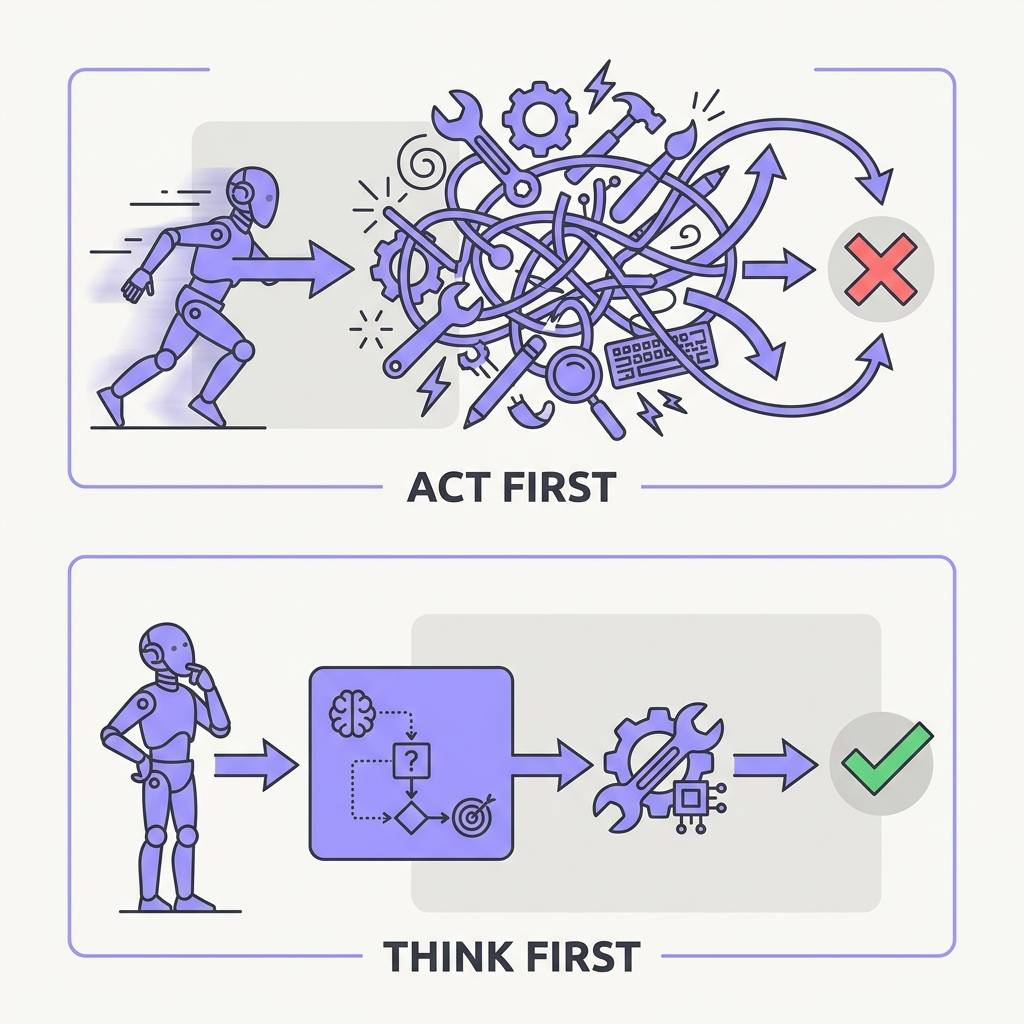
The principle
Prompting a model to reason in steps before answering measurably improves results — and for an agent the asymmetry is brutal: a reasoning trace is cheap and reversible, but an executed action (a sent email, a dropped table, a charged card) is not. Letting the model lay out its plan in tokens before it commits is the cheapest insurance you can buy.
Why it happens
Reasoning before acting works because generating intermediate tokens lets the model condition its final decision on its own externalized plan rather than committing in a single forward pass, and for agents this turns a cheap, reversible artifact into a gate before an expensive, irreversible one. ReAct (Yao et al., 2022) showed why interleaving reasoning with action specifically helps agents: the reasoning trace lets the model track state, handle exceptions, and adjust the plan, and it reduced the hallucination and error propagation that plague act-only loops, beating imitation and RL baselines on interactive benchmarks by up to 34% absolute. The asymmetry is the whole point: a few hundred reasoning tokens cost almost nothing and can be discarded, but an executed DELETE, a sent email, or a charged card cannot be unsent. Forcing an explicit plan-then-act step is the cheapest insurance available against a wrong irreversible action.
Watch for
- The agent fires a side-effecting tool call with no stated plan or scope beforehand.
- Destructive actions execute on the first instinct, then turn out to have hit the wrong target.
- Post-mortems show the agent never articulated what it was about to do or why.
In practice
Your ops agent gets 'clean up the staging records' and immediately fires a DELETE, dropping rows a teammate needed because it never reasoned about scope. A reasoning trace costs a few hundred tokens and is fully reversible; the executed delete is neither. Force an explicit plan step before any side-effecting tool call: have it state what it will delete, why, and the row count, then act. Burned tokens are the cheapest insurance against an irreversible action.
Apply it
- Require an explicit reasoning or plan step before any tool call that has side effects.
- Make the plan state the exact target, scope, and expected effect (for example the row count) before acting.
- Treat reasoning tokens as cheap insurance and spend them freely ahead of any irreversible action.
The takeaway
Force an explicit reasoning or plan step before any tool call with side effects. Burned tokens are far cheaper than a wrong action.