Law 20 · Scope & Design
The Cheapest Fix First
Reach for the prompt before the platform.
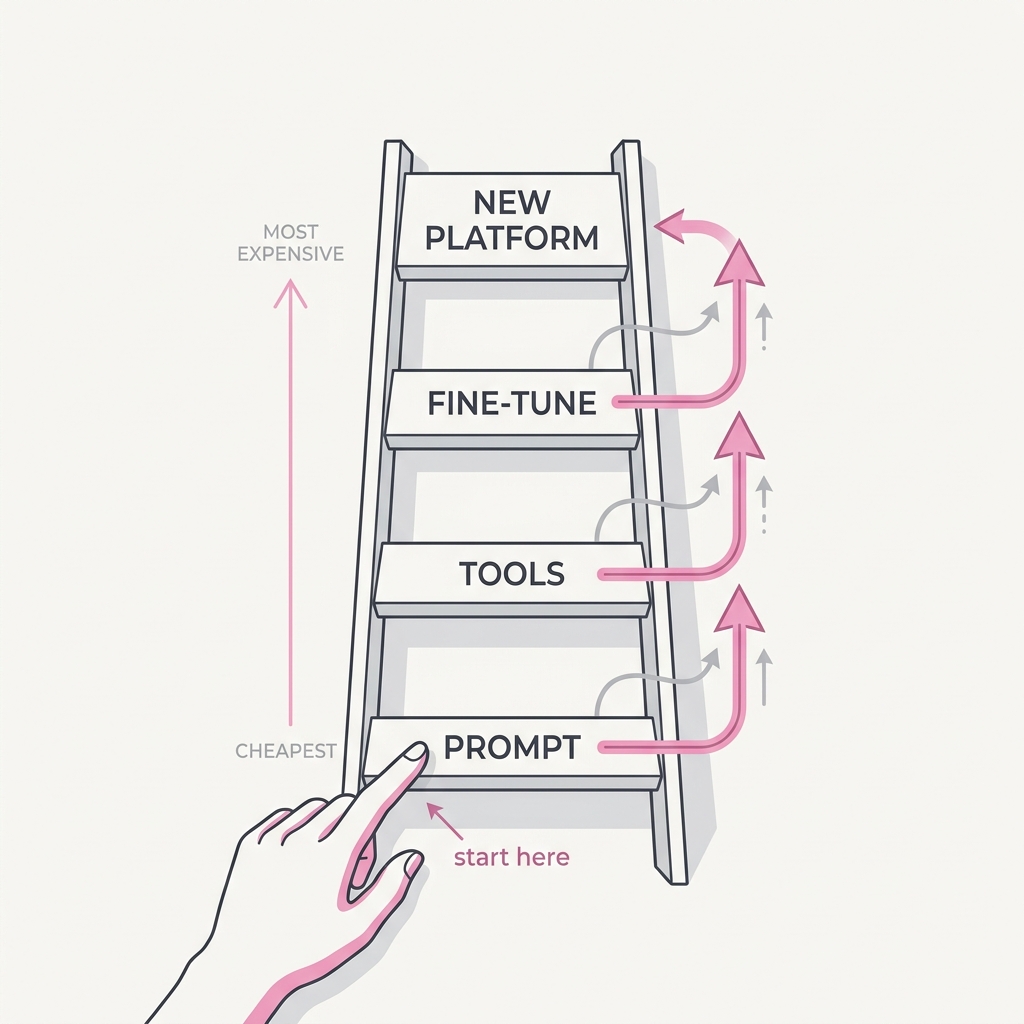
The principle
When something misbehaves, the cheapest fix that addresses the root cause usually wins — and it's usually clearer instructions, a better tool description, or a concrete example, not a new classifier, preprocessing layer, or pipeline. Infrastructure feels like progress but often just wraps an unsolved prompt in more surface area.
Why it happens
Most agent misbehavior traces to an underspecified instruction, a vague tool description, or a missing example, and these have a root-cause fix that costs words rather than systems, so reaching for a classifier or preprocessing pipeline often just wraps the unsolved prompt in more surface area to maintain. New infrastructure feels like progress because it produces artifacts, but it adds latency, failure modes, and debugging cost without addressing why the model chose wrong. Practitioners who shipped LLM products at scale converged on starting simple: a few sentences of instruction and a couple of examples, adding complexity only as concrete failures force it, because premature machinery hides the real defect. The disciplined order is to exhaust prompt-level fixes, clearer instructions, sharper tool descriptions, and concrete examples, and build systems only once you have proven words genuinely cannot close the gap.
Watch for
- A new service or pipeline is being specced before anyone rewrote the failing instruction or tool description.
- Infrastructure was added but the original misbehavior persists.
- The actual defect is a vague description the model cannot act on, masked by surrounding machinery.
In practice
The agent keeps picking the wrong tool, so you spec out an intent-classifier service and a preprocessing layer, and three days of infrastructure later it still misfires, because the real problem was a tool described as 'searches the database' that the model could not tell apart from another. Infrastructure feels like progress while it just wraps an unsolved prompt in more surface area. Exhaust the cheap fixes first: rewrite the tool description, add two concrete examples, tighten the scope. Build the system only after you have proven words genuinely cannot close the gap.
Apply it
- Diagnose the root cause and try clearer instructions, sharper tool descriptions, and concrete examples first.
- Start with the simplest prompt that could work and add complexity only when a real failure forces it.
- Build new infrastructure only after proving that prompt-level fixes genuinely cannot close the gap.
The takeaway
Exhaust the prompt-level fixes before you build systems. Only add infrastructure once you've proven that words, examples, and scoping genuinely can't close the gap.