Law 24 · Instruction & Output
Surface Ambiguity, Don't Resolve It
When the data is unclear, don't guess confidently.
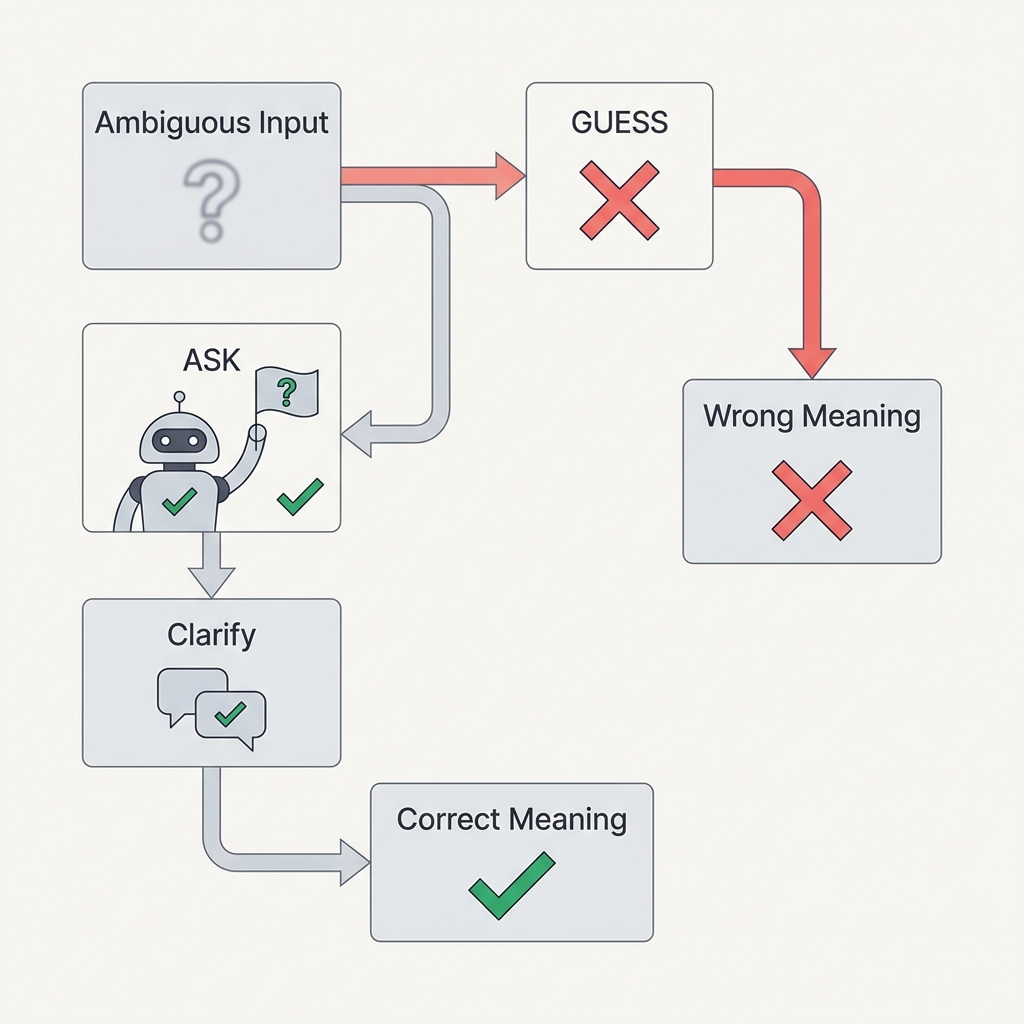
The principle
Faced with two plausible matches, conflicting sources, or a missing field, an agent's instinct is to pick the 'most likely' option and move on — a confident choice that silently buries the doubt. When the stakes touch identity, money, or anything irreversible, a quiet wrong guess is far worse than an honest 'this is unclear'.
Why it happens
Models are trained to be helpful and to produce an answer, which biases them toward resolving ambiguity by silently picking the most likely option rather than flagging that the question is unanswerable as posed. A benchmark of unanswerable and underspecified questions found that even strong models often fail to abstain, and notably that reasoning-focused fine-tuning made abstention worse, degrading it by about 24% on average, so more capable models are not automatically more cautious. The danger is that the confident pick looks identical to a correct answer downstream, so the buried doubt never surfaces until reconciliation. Crucially, the same work showed that simply offering an explicit abstention option makes models abstain far more reliably, which means the fix is structural, not a matter of better prompting alone.
Watch for
- The agent commits to one of several plausible matches without recording that alternatives existed.
- A required field is always filled, even when the source data plainly lacks the value.
- Conflicting sources get silently reconciled into a single clean answer with no trace of the disagreement.
In practice
An invoice-matching agent finds two vendors named 'Acme LLC' with different tax IDs and confidently picks the one with the higher historical volume, routing a $40k payment to the wrong account. Nobody notices until reconciliation, because the output looked clean and decisive. The agent should have stopped and flagged it: preserve both candidate records with their tax IDs and source rows, and request a second identifier or a human decision. When money, identity, or anything irreversible is on the line, an honest 'this is ambiguous' beats a tidy wrong answer every time.
Apply it
- Give the agent an explicit way to abstain or escalate, and make unclear a valid, low-friction output.
- On a tie or a conflict, preserve every candidate with its source instead of collapsing to one.
- For irreversible or identity, money, or safety-critical decisions, route ambiguity to a human or request a second identifier before acting.
The takeaway
Make the agent escalate ambiguity instead of papering over it: ask for another identifier, preserve both conflicting values with their sources, flag the conflict for a human. Surface the doubt to whoever can actually resolve it.