Law 19 · Scope & Design
Decompose Before You Scale
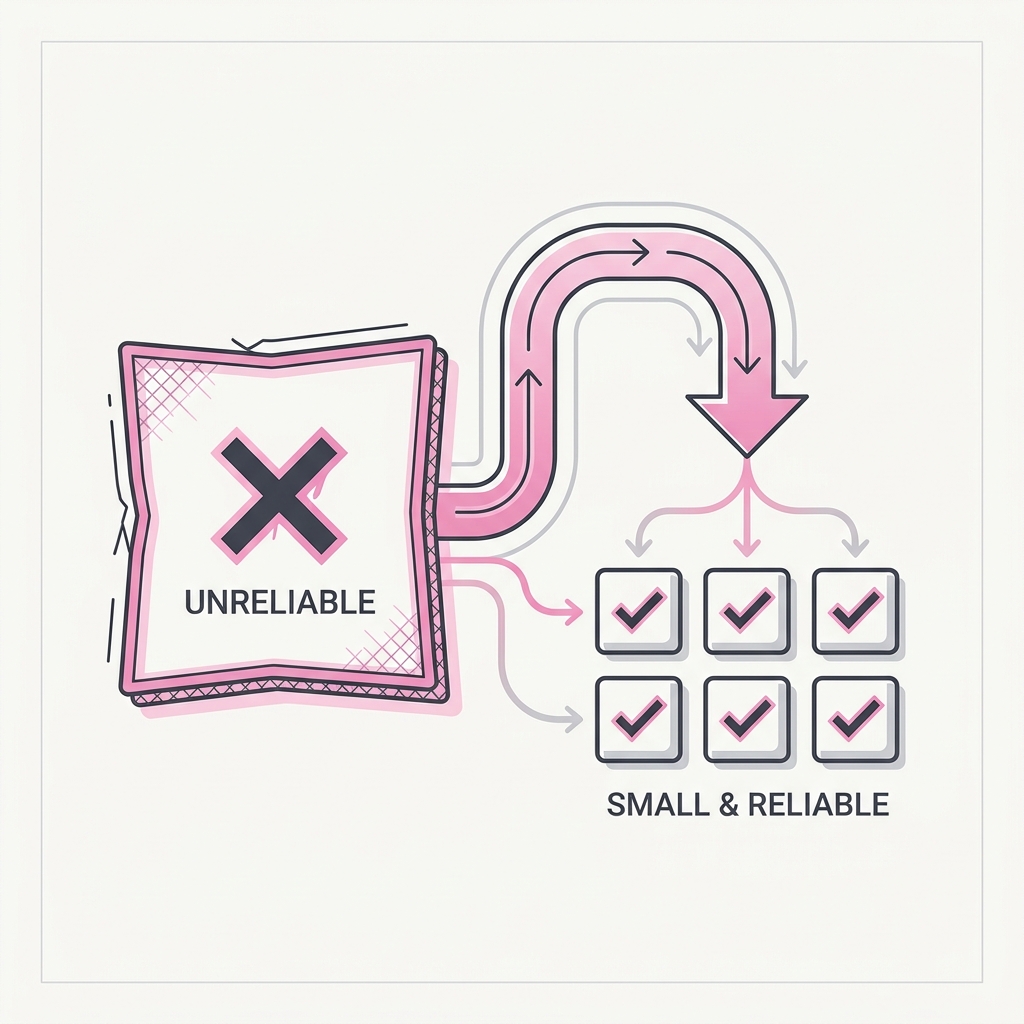
When it's unreliable, split it — don't supersize it.
The principle
When output is inconsistent, the instinct is to throw more at the same shape: a bigger model, a longer context, more tokens. That rarely fixes a structural problem — it just dilutes attention further. Splitting the task into focused, single-purpose passes almost always beats making one overloaded pass smarter.
Why it happens
When one pass is asked to do many things at once, the model must split a fixed attention budget across every sub-goal, so adding a bigger model or longer prompt often dilutes focus further instead of fixing the structural overload. Decomposing the task into focused single-purpose passes lets each step be prompted, examined, and optimized in isolation, which is why staged approaches consistently beat one heroic pass on multi-step work. Least-to-most prompting showed that solving easier sub-problems first and feeding their results forward generalizes far better than tackling the whole task in one shot, and decomposed prompting generalized this into a modular library of sub-task solvers that each step can call or further break down. The practical move is to analyze per item in a tight pass, then reconcile across items in a separate pass, rather than overloading a single call.
Watch for
- A single pass handling many items is inconsistent, and a bigger model or longer prompt makes it blurrier, not sharper.
- One call is responsible for several distinct sub-tasks at once.
- Errors cluster on the hardest sub-step that is buried inside an overloaded prompt.
In practice
Your invoice extractor is inconsistent across 30-line documents, so you reach for a bigger model and a longer prompt, and it gets blurrier, not sharper, because one overloaded pass is splitting attention across every row. The instinct to supersize masks a structural problem. Split it instead: extract each line item in a focused per-item pass, then run a separate reconciliation pass to total and cross-check. Several stages that each do one thing well beat one heroic pass trying to do everything.
Apply it
- Split the work into stages that each do one thing, like extract per item, then reconcile across items.
- Solve simpler sub-problems first and feed their results into later steps rather than answering all at once.
- Optimize and inspect each focused pass in isolation instead of supersizing one overloaded call.
The takeaway
Break the work into stages that each do one thing well — analyze per-item, then reconcile across items. A focused pass beats a heroic pass trying to do everything at once.